
The Connection Imperative: Why Great Leaders Must Build Real Relationships

Updated: Jul 31, 2025
A Strategic Framework for Authentic Leadership Through Meaningful Relationships
The most successful leaders I've worked with share one defining characteristic: they understand that leadership is fundamentally about relationships. Not playing a role. Not assembling a portfolio. Building genuine, strategic relationships that create mutual value and drive organizational success.
After hundreds of conversations with executives and observing thousands of leadership interactions, I've come to a stark realization: your ability to build authentic relationships is the leadership skill that determines everything else.
The Relationship Imperative for Leaders
The data tells a compelling story. High-trust businesses are 2.5 times more likely to be high-performing revenue companies compared to their low-trust counterparts. But here's the kicker: trust doesn't magically appear in quarterly reports. It's built through consistent, authentic relationships where leaders show up as actual human beings instead of corporate robots with leadership titles.
Trusting employees are 260% more motivated to work, have 41% lower rates of absenteeism, and are 50% less likely to look for another job. These aren't just feel-good HR metrics. These are the building blocks of organizational resilience, innovation, and competitive advantage.
The equation is brutally simple: Better relationships equal better leadership. Better leadership equals better business results. Skip the relationships, and you're essentially playing leadership on hard mode with a blindfold on.
The Four Types of Leadership Relationships
Here's where most leaders get it wrong. They think all relationships should be "deep and meaningful," or they dismiss lighter connections as "small talk." Both approaches will sabotage your effectiveness.
I've developed a framework that categorizes leadership relationships not by hierarchy or function, but by their depth and authenticity because that's what actually determines their power to drive results.

The framework operates on two critical dimensions:
Authenticity Axis: Real vs. Manipulative connections
Depth Axis: Deep vs. Superficial connections
Think of it as your relationship GPS. It tells you where you are and where you need to go.
Quadrant 1: Real & Superficial — The "Fun" Zone

These are authentic but surface-level connections. These are your authentic but lighter connections. Before you roll your eyes and dismiss them as "not worth your time," or “not part of your job,” consider this: these relationships create the psychological safety that makes everything else possible. Think of the executive who genuinely enjoys the company golf outing, the leader who brings levity to team meetings, or the CEO who remembers your kid's soccer game results.
Professional Examples:
Authentic team building that brings out genuine personality
Celebrating small wins without making it feel like a performance
Regular informal check-ins that aren't thinly veiled performance reviews
Celebrating personal milestones and showing genuine interest
Creating moments of levity that reduce organizational tension
Why It Matters: These connections create psychological safety and belonging. Employees who feel they belong are 7x more engaged, that’s why Gallup always asks if you have a best friend at work. While not deep, these relationships form the foundation of trust that enables deeper collaboration. Without these connections and the social capital they build, being approachable or successfully having difficult conversations is infinitely more challenging.
The Leadership Edge: These relationships may feel to some like small talk, but they’re more important than one may think. They're the foundation that makes Big Talk possible. Leaders who dismiss these connections as "soft" miss the strategic value of emotional bank accounts.
Quadrant 2: Real & Deep — The "Power" Zone

This is where leadership magic happens, and where most leaders are too scared to go. These relationships require vulnerability, mutual investment, and the courage to be changed by the interaction.
Professional Examples:
Mentorship relationships
Deep developmental and coaching relationships with high-potential team members
Strategic partnerships with peers who challenge your thinking
Leadership team dynamics where vulnerability and challenge coexist
Why These Relationships Are Your Secret Weapon:
They enable honest feedback and course correction (before you crash and burn)
They create alignment on vision and values that transcend job descriptions
They build the trust necessary for real delegation (not micromanagement disguised as "support")
They become your leadership force multipliers and succession pipeline
The Leadership Edge: These connections become your thought partners for the biggest decisions and your support system for the hardest challenges. They're the connections and conversations that will tell you what you need to hear, not what you want to hear.
Quadrant 3: Manufactured & Superficial — The "Empty" Zone
(Where Good Intentions Go to Die)

Here's the uncomfortable truth: most leaders spend more time in this quadrant than they'd like to admit. And here's the even more uncomfortable truth—it's not always intentional.
This isn't about mustache-twirling villains plotting to deceive their teams. This quadrant is filled with well-meaning leaders who've fallen into manufactured patterns without even realizing it. It's the leader who organizes team lunches but uses them to gather intel on office dynamics. The executive who asks about your weekend but is really fishing for commitment levels. The manager who creates an "open door policy" that somehow feels more like a surveillance system.
These connections happen constantly because they're easy to justify and hard to recognize. After all, you're "building relationships" and "being interested in your people." The manufacturing is subtle—it's not what you're doing, it's why you're doing it. When relationship-building becomes a means to an end rather than valuable in itself, you've crossed into manufactured territory.
Warning Signs You're Here:
Your "relationship building" has a hidden agenda
Conversations feel like data mining operations
"We're like family" rhetoric that isn't backed by action
Team members give you surface-level responses and seem perpetually guarded
The Hidden Cost: Your team can sense when relationship-building efforts are manufactured. And in return, you’ll get compliance instead of commitment, and mediocre performance instead of excellence. 83% of consumers will not do business with brands they don't trust—your employees operate by the same principle.
The Course Correction: Stop asking "What can I get from this relationship?" Start asking "What can I give to this relationship?"
Quadrant 4: Manufactured & Deep — The "Dangerous" Zone
(Organizational Kryptonite)
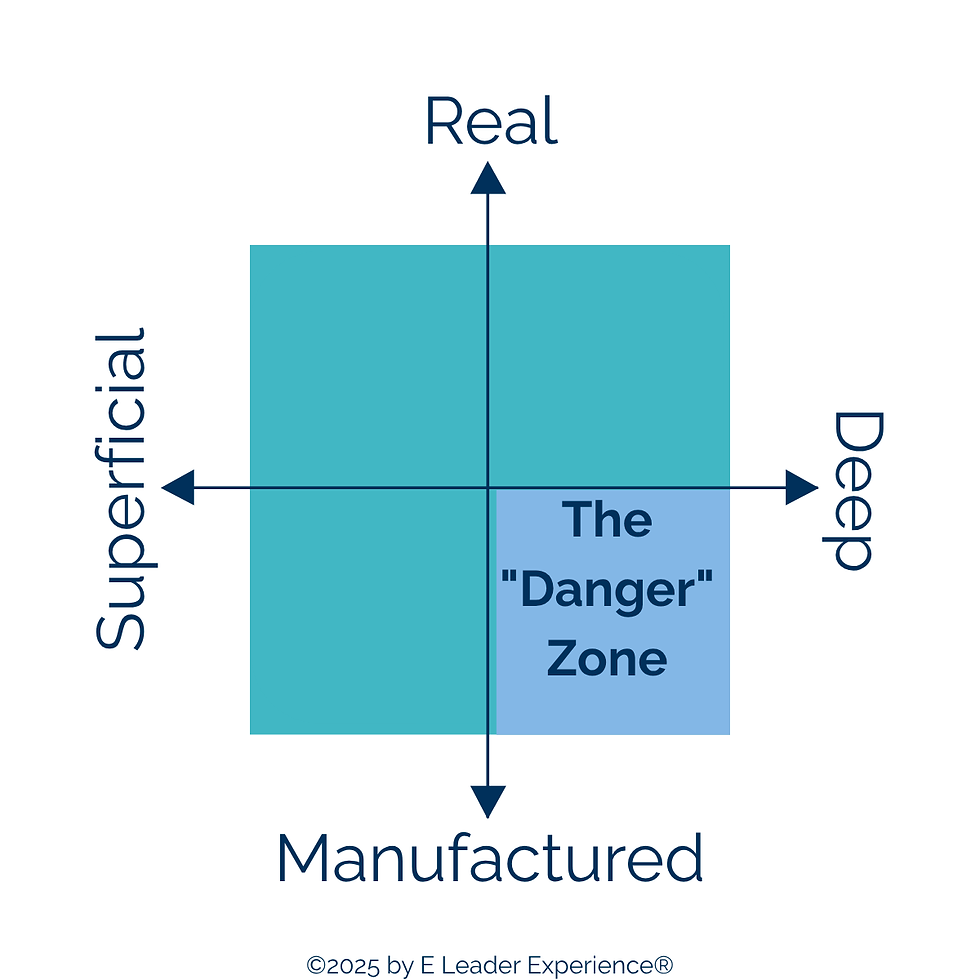
This quadrant is rarer than the superficial manufactured but infinitely more dangerous. Most leaders don't intentionally set out to be manufactured at deep levels, but the road to toxic leadership is paved with good intentions and unchecked power dynamics.
This often starts innocently enough. A leader begins building genuine, deep connections such as mentoring relationships, strategic partnerships, and personal bonds with team members. But somewhere along the way, the power dynamic shifts. Maybe it's the pressure to deliver results, the seduction of having influence, or simply the gradual erosion of boundaries that comes with authority.
What makes this quadrant particularly insidious is that it often begins as an authentic relationship-building effort. The manufactured creeps in slowly: using personal information as leverage during tough conversations, making people feel "special" to increase their commitment to your agenda, or creating emotional dependency to ensure loyalty. The relationships feel real to both parties—until they don't.
Organizational Consequences:
Politics overshadow purpose and mission
Psychological safety evaporates faster than your retention rates
High-potential talent exits (and they don't give you honest exit interviews)
Innovation dies as people focus on self-protection instead of contribution
The Ripple Effect: These relationships poison entire cultures and can take years to recover from. Leaders operating here create environments where fear masquerades as respect and compliance is mistaken for engagement.
Your Relationship Strategy Audit
Map Your Current Relationship Portfolio:
Identify your key stakeholder relationships across all four quadrants (be honest)
Assess where you're investing most of your relationship energy (prepare to be surprised)
Spot the gaps—which important relationships are underdeveloped? (spoiler: probably the deep ones)
Recognize which relationships might be accidentally manipulative (this one stings, but it's necessary)
Shift Your Relationship Approach:
Lead with curiosity, not agenda: Start with understanding their world before sharing yours
Invest in consistency over intensity: Regular touchpoints build stronger bonds than sporadic grand gestures
Practice vulnerable leadership: Share appropriate challenges and uncertainties
Create value before asking for value: What can you offer that serves their success?
The Relationship-Driven Future
As artificial intelligence handles more transactional work, the uniquely human ability to build meaningful relationships becomes even more valuable. Leaders who master this skill create environments where people choose to bring their best work, their creative ideas, and their sustained commitment.
The Leadership Imperative
Great leaders understand that every interaction is either building or eroding relationship capital. In our hyperconnected but increasingly isolated business world, the ability to create genuine human connections isn't just a soft skill—it's your competitive differentiator.
The leaders who will thrive aren't those with the largest networks, but those with the strongest relationships. They understand that leadership isn't about having all the answers—it's about building relationships with people who can help you find the right questions.
The Bottom Line: Your technical skills might get you promoted to leadership, but your relationship skills determine whether you succeed once you're there. And unlike technical skills, relationship skills can't be automated, outsourced, or replaced by AI.
Remember: Leadership is not about being the smartest person in the room. It's about building relationships with smart people and creating an environment where their collective wisdom can flourish. Now go build some real relationships.


Comments